
Zygomatic implants in Bangalore offer a graftless solution for severe upper jawbone loss. Learn how Dr. Srinivas Rao provides immediate fixed teeth.
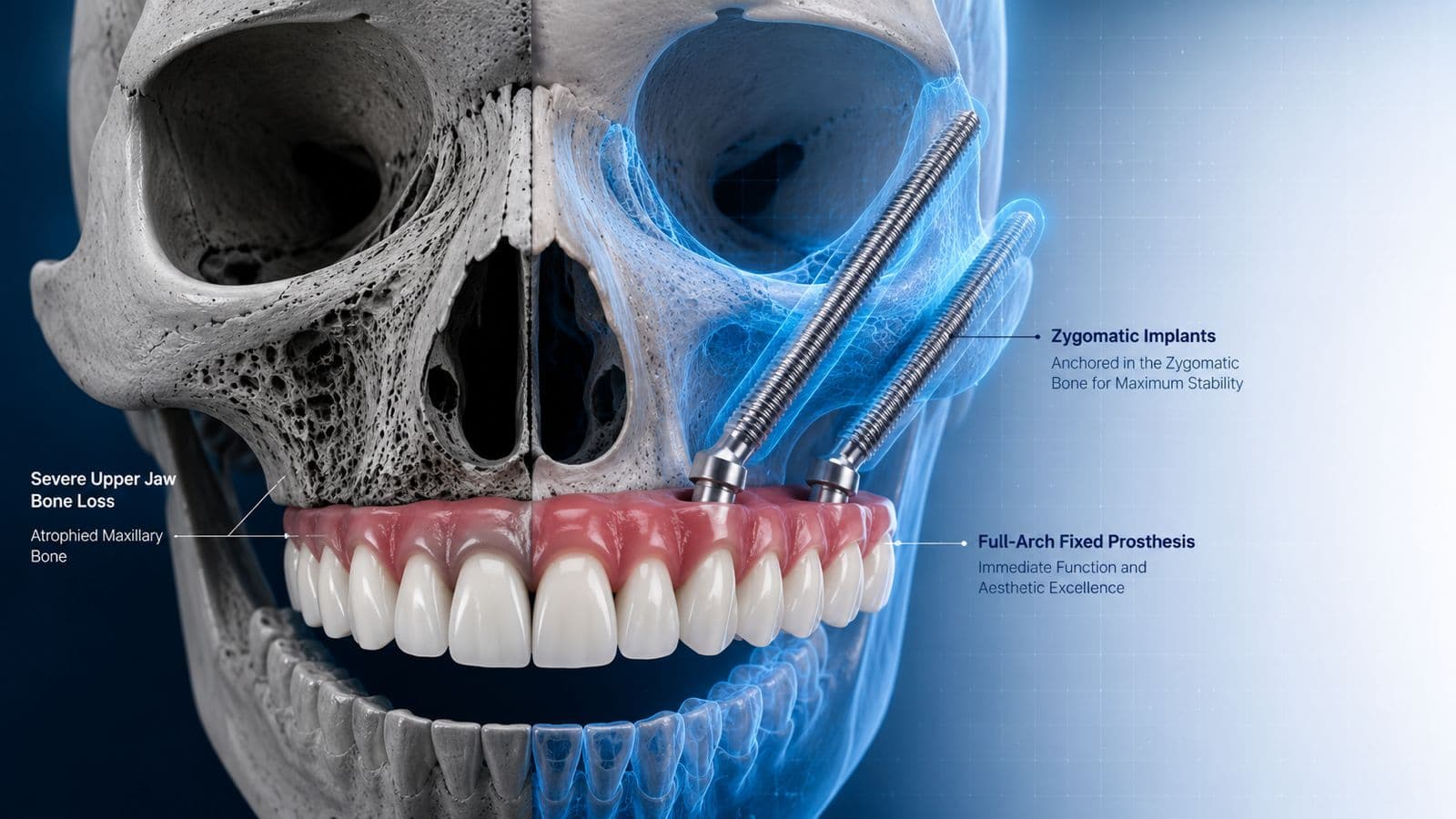
For patients suffering from severe upper jawbone loss, traditional dental implants can present significant clinical challenges. Years of missing teeth, advanced periodontal disease, prolonged denture wear, or surgical maxillectomy can leave the upper jawbone (maxilla) severely resorbed or hollow. When conventional jawbone height is less than a few millimeters, general dentists often inform patients that dental implants are biologically impossible—or propose extensive, multi-stage bone grafting procedures with uncertain outcomes.
Fortunately, modern maxillofacial implantology offers a revolutionary, Scandinavian-proven solution: Zygomatic Implants in Bangalore. By anchoring directly into the dense, non-resorbable cortical bone of the cheekbone, zygomatic implants bypass the upper jaw entirely. In this detailed clinical guide, we explore when regular implants fail, how cheekbone implants work, why they eliminate bone grafts, and why specialized surgical expertise is essential for a safe, permanent result.
Zygomatic implants are specialized, extra-long (30mm to 55mm) dental implants anchored directly into the dense cortical bone of the cheekbone (zygoma) to support fixed teeth in patients with severe upper jawbone atrophy. Developed by Swedish orthopedic pioneer Professor Per-Ingvar Brånemark, these advanced implants utilize the cheekbone as a biological fortress when the maxillary jawbone lacks adequate volume.
Unlike the maxillary alveolar bone, which naturally shrinks and resorbs following tooth extraction or age-related bone loss, the zygomatic cheekbone retains its dense, high-volume cortical structure throughout a person's lifetime. Zygomatic implants pass through the upper jaw sinus region at precise surgical angles, securing firm mechanical anchorage (bicortical fixation) in the cheekbone.
The surgical trajectory involves inserting the titanium implant post through the palate or sinus cavity wall and locking the threaded tip into the dense outer cortex of the zygomatic body. Because the cheekbone is composed of thick cortical bone that resists resorption, the implant achieves immediate rigid stability upon insertion.
Using 3D Cone Beam CT (CBCT) volumetric scanning, the surgical team virtually maps nerve pathways, sinus membranes, and orbital boundaries. This pre-operative digital simulation ensures that the implant drill path remains completely isolated from delicate anatomical structures.
This solid cheekbone anchorage provides immediate stability, allowing a complete arch of fixed artificial teeth to be attached securely without waiting for months of uncertain bone regeneration.
Zygomatic implants differ from conventional dental implants by anchoring into the cheekbone rather than the maxillary jawbone, utilizing lengths up to four times longer to achieve immediate mechanical stability. While conventional implants range from 8mm to 15mm in length and rely on localized jawbone volume, zygomatic implants span 30mm to 55mm and utilize remote skeletal anchorage.
The table below highlights the key anatomical and surgical differences between conventional and zygomatic implant systems:
| Feature | Conventional Implants | Zygomatic Implants |
|---|---|---|
| Anatomical Anchor Site | Alveolar Jawbone (Maxilla) | Zygomatic Bone (Cheekbone) |
| Implant Length Range | 8mm to 15mm | 30mm to 55mm |
| Bone Graft Requirement | Mandatory in severe atrophy | 100% Completely Avoided |
| Time to Fixed Teeth | 6 to 18 months (if grafted) | Immediate (Within 24 Hours) |
| Surgical Specialty Required | General Dentist / Implantologist | Maxillofacial Prosthodontist |
To review standard implant solutions for moderate bone volume, consult our Dental Implants Service Guide.
Candidates for zygomatic implants include individuals with severe upper jawbone resorption, failed conventional implants, post-cancer or mucormycosis maxillofacial defects, and long-term denture wearers. Zygomatic implantology serves as the ultimate restorative treatment when standard options have failed or proven inadequate.
Specifically, zygomatic implants are recommended for five primary clinical scenarios:
• Severe Maxillary Resorption: Patients who have experienced total bone loss in the upper jaw due to decades of missing teeth or loose removable dentures.
• Failed Bone Grafts or Sinus Lifts: Patients who underwent previous sinus augmentation or bone block grafting that failed to integrate or collapsed over time.
• Failed Conventional Implants: Individuals who suffered multi-implant failure in the upper jaw due to peri-implantitis or poor primary stability.
• Post-Mucormycosis or Tumor Resection: Patients who required surgical removal of maxillary bone following black fungus (mucormycosis) infection or oral cancer treatment.
• Congenital Maxillary Defects: Individuals born with cleft palate or severe ectodermal dysplasia lacking normal upper jawbone development.
For complex facial prosthetic rehabilitations involving ocular, nasal, or ear prostheses, visit our specialized Maxillofacial Anaplastology Center.
The Quad-Zygoma technique utilizes four zygomatic implants—two placed into each cheekbone—to completely reconstruct the upper arch when zero anterior or posterior jawbone remains. In extreme cases of bone resorption where not even two standard anterior implants can be placed, the Quad-Zygoma approach provides a complete four-corner skeletal foundation.
By anchoring two implants into the right cheekbone and two into the left cheekbone, the surgical team creates a rigid quad-angular frame across the mid-face. This allows full-arch immediate prosthetic loading even in patients who have been completely toothless and bone-deficient for 30 or 40 years.
Post-mucormycosis and oncological maxillary reconstruction using zygomatic implants restores full chewing capability and facial volume for patients who have undergone partial or total maxillectomy. Following surgical removal of infected or cancerous maxillary bone tissue, patients are left with massive anatomical defects that make speaking, swallowing, and chewing exceptionally difficult.
Traditional obturator dentures often leak fluids into the nasal cavity and lack retention. By placing two to four quad-zygomatic implants into the remaining intact cheekbones, maxillofacial prosthodontists can anchor custom titanium or PEEK framework prostheses. This bridges the surgical defect, seals the oral-nasal cavity, and restores symmetrical facial contours.
Zygomatic implants eliminate the need for bone grafting and sinus lifts by bypassing weak or absent jawbone tissue and anchoring directly into the permanently dense cheekbone. Traditional reconstruction of a severely resorbed upper jaw requires invasive bone harvesting from the hip (iliac crest) or tibia, followed by major sinus elevation surgery.
Traditional bone grafting presents three major drawbacks for patients:
1. Extended Treatment Timelines: Bone grafts require 6 to 9 months to heal before implants can be placed, followed by another 6 months of osseointegration. Patients remain without fixed teeth for up to 18 months.
2. Multiple Surgical Sites & Pain: Harvesting autogenous bone requires a secondary donor surgical site, increasing post-operative pain, hospital stays, and surgical risks.
3. High Resorption Failure Rates: Grafted bone in severe maxillary atrophy frequently resorbs or fails to integrate, leading to high failure rates when implants are eventually inserted.
In contrast, zygomatic implants bypass the pneumatic sinus cavity using an extra-sinus or intra-sinus surgical approach. The titanium post engages the thick cheekbone body, which provides natural cortical density that does not shrink over time.
By anchoring directly into the cheekbone, zygomatic implants bypass these hurdles entirely, transforming an 18-month multi-surgical ordeal into a single, predictable 24-hour treatment.
Immediate loading with zygomatic implants allows surgical teams to attach a rigid, custom-fabricated provisional acrylic bridge within 24 hours of surgery. Because the cheekbone provides dense cortical anchorage, zygomatic implants achieve exceptional primary insertion torque—typically exceeding 45 to 50 Ncm.
This immediate mechanical stability enables the "cross-arch splinting" principle. By connecting two or four zygomatic implants together with a rigid titanium-reinforced provisional bridge, masticatory chewing forces are distributed evenly across the facial skeleton.
The protocol follows four precise clinical phases:
• Phase 1 (Pre-op 3D Planning): 3D CBCT scan mapping cheekbone entry angles and virtual CAD simulation.
• Phase 2 (Guided Surgical Placement): Placement conducted under safe general anesthesia inside a sterile hospital operatory.
• Phase 3 (Digital Impression Transfer): iTero digital optical scanning of multi-unit abutment positions immediately post-op.
• Phase 4 (24-Hour Provisional Delivery): Direct insertion of a screw-retained, custom-milled provisional bridge restoring speech and chewing.
Patients walk out of the clinic the next day with a full set of non-removable, fixed teeth, enabling them to smile, speak clearly, and enjoy soft foods immediately while biological healing progresses.
Long-term maintenance and hygienic care for zygomatic implant restorations ensure permanent biological stability and healthy surrounding tissue contours. Because zygomatic implants feature long transmucosal profiles passing into the oral cavity, maintaining clean mucosal tissue interfaces is vital.
Patients with zygomatic restorations benefit from using oral irrigators (Waterflossers), specialized interdental brushes, and non-abrasive chlorhexidine rinses. Routine 6-month clinical checkups at Maxface Clinic include professional ultrasonic scaling, screw tightness checks, and occlusal force adjustments to maintain long-term success.
Operating theater safety protocols for zygomatic implantology ensure sterile surgical fields and general anesthesia monitoring to guarantee absolute patient comfort. Because zygomatic placement involves navigating deep mid-facial anatomy near the infraorbital margin, procedures are conducted under general anesthesia or deep IV conscious sedation inside fully equipped hospital operating suites.
Maxface Dental Clinic collaborates with accredited hospital operating centers in Bangalore, providing continuous cardiac monitoring, anesthesiologist supervision, and Class-B sterile surgical suites. This hospital-grade setup ensures maximum safety for elderly patients or individuals with complex medical histories.
Zygomatic implant placement demands specialized maxillofacial surgical training because the extra-long implant trajectory passes close to the orbit, maxillary sinus, and neurovascular structures. Unlike standard dental implants placed in straightforward jawbone sites, zygomatic placement requires master-level knowledge of complex mid-facial anatomy.
Globally, fewer than 1% of practicing dental surgeons possess the formal surgical training and hospital credentials required to perform zygomatic implant surgery safely. Incorrect implant trajectories can lead to sinus complications, orbital injury, or chronic facial nerve paresthesia.
At Maxface Dental Clinic, chief surgeon Dr. B. Srinivas Rao, MDS, is one of India's foremost authorities in zygomatic implantology:
• Brånemark Osseointegration Centre Fellow & Mentor: Trained directly under Scandinavian protocols established at the Brånemark Centre in Gothenburg, Sweden, and serves as a clinical mentor teaching advanced zygomatic procedures to postgraduate surgeons.
• Fellow & Diplomate, ICOI (USA): Certified by the world's largest implant organization for exemplary complex-case clinical outcomes.
• NHS Hospital Surgical Experience: Former Clinical Associate in NHS Scotland hospital trusts, managing severe facial trauma and oncological jaw reconstructions.
Dr. B. Srinivas Rao is a published research authority in zygomatic implantology, having authored peer-reviewed literature on stress distribution and consensus protocols for edentulous maxilla rehabilitation. Active involvement in scientific research guarantees that every patient receives care based on empirical data rather than commercial claims.
Dr. Srinivas Rao's scientific contributions include published papers in prestigious international journals such as Clinical Oral Implants Research and the Journal of Prosthetic Dentistry. His research explores finite element stress analysis of quad-zygoma frameworks, PEEK polymer shock absorption, and computer-guided 3D surgical templates.
By analyzing how occlusal forces travel through cheekbone-anchored titanium posts, Dr. Srinivas Rao designs frameworks that minimize stress concentration, preventing screw loosening or mechanical prosthetic fractures.
When you choose Maxface Dental Clinic in Kasturinagar, East Bangalore, your zygomatic reconstruction is planned using 3D CBCT computer simulation, executed inside a sterile hospital operatory, and backed by over two decades of surgical excellence.
Yes, zygomatic implants are exceptionally safe when placed by a trained maxillofacial specialist. They have a documented long-term clinical success rate of 97.8% over ten years. Using 3D CBCT scans and guided surgical protocols ensures that the implant trajectory stays safely clear of vital anatomical structures.
Zygomatic implants are designed to be a permanent, lifetime tooth replacement solution. Because the cheekbone (zygoma) does not resorb like the maxillary jawbone, the anchorage remains dense and structurally stable indefinitely with proper oral hygiene and routine maintenance.
Yes. In over 95% of clinical cases, zygomatic implants achieve high primary insertion torque (above 45 Ncm), allowing immediate loading. A custom, aesthetically pleasing provisional fixed bridge is securely attached to the implants within 24 hours of placement.
Uncontrolled systemic medical conditions, active acute maxillary sinus infections, heavy unmanaged bisphosphonate therapy, or severe active bone pathologies are contraindications. A thorough 3D CBCT radiographic evaluation and medical clearance determine your candidacy.
No. Zygomatic implant surgery is performed under general anesthesia or deep IV conscious sedation inside a sterile hospital environment. You will feel zero pain during the procedure. Post-operative discomfort and minor cheek swelling are easily controlled with prescribed anti-inflammatory medications.
Zygomatic implants eliminate the need for secondary bone harvesting surgical sites, reduce overall treatment time from 18 months down to 24 hours, and eliminate the high risk of bone graft resorption or failure in severely atrophic upper jaws.
At Maxface Dental Clinic in Bangalore, zygomatic implant procedures enjoy a clinical success rate exceeding 98%. Dr. Srinivas Rao utilizes Swedish Scandinavian surgical protocols and 3D computer-guided planning for predictable outcomes.
Medically Reviewed By
MDS Prosthodontics, Fellow & Diplomate ICOI (USA) · Chief Implantologist · Last updated: May 2026
A clinical case series by Dr. B. Srinivas Rao demonstrating how patients with severely resorbed jawbones — previously told they cannot receive implants — were successfully rehabilitated using zygomatic implants and the All-on-4 treatment concept.
Find the best dental implant clinic in Bangalore. Maxface Clinic offers Sweden-trained prosthodontic expertise and 3D digital implant planning.
Full mouth dental implants in Bangalore: Compare All-on-4 vs All-on-6 procedures. Learn how Dr. Srinivas Rao selects the optimal full arch treatment.